UK support for centrifugal feeding projects
01844 617223sales@sortationsolutions.co.uk
Budget and quotation guidance

Centrifugal feeder cost and pricing.

Understand what drives the price of a complete centrifugal feeding system and prepare the information needed for a useful quotation.

Direct answer

How much does a centrifugal feeder cost?

A centrifugal feeder is normally an application-engineered system, so there is no responsible universal price. The useful figure is the cost of delivering the approved component in the correct orientation, at the required sustainable rate and into the receiving machine.

A bowl-only figure can omit the equipment that makes the feeder productive: bulk storage, part-specific tooling, tracks, accumulation, escapement, sensors, controls, guarding, trials and integration. A quotation should make each boundary visible.

Fastest route to a useful budget

Send representative parts or drawings, all variants, the required orientation, accepted parts per minute and details of the downstream machine. A short component review is more accurate than selecting a feeder by diameter.
Cost drivers

What changes the price of a parts feeding system?

Cost follows technical scope and risk. These areas should be reviewed before comparing quotations.

01

Component difficulty

Nesting, tangling, symmetry, static, fragility and cosmetic finish influence tooling and trials.

02

Orientation requirement

Simple separation costs less to prove than complex face, axis and rotational presentation.

03

Sustainable output

Higher accepted rates may require more bowl capacity, lanes, accumulation or parallel systems.

04

Bulk autonomy

Hopper volume, elevator, level control and refill method determine unattended running time.

05

Outfeed and release

Tracks, conveyors, escapements and verification are engineered around the machine hand-off.

06

Controls and compliance

PLC logic, recipes, sensing, guarding, documentation and validation requirements affect scope.

Quotation comparison

Compare the accepted production outcome.

A lower headline price may exclude the equipment or testing needed to achieve reliable feed at the real line interface.

Quotation areaWhat should be statedWhy it matters
Approved partsExact variants, batches, materials and sample references included in scope.Prevents one successful sample being treated as approval for the full production family.
Accepted orientationPosition, rotation, spacing and tolerance at the defined hand-off point.Makes the promised result measurable.
Sustainable rateAccepted parts per minute, test duration, replenishment and permitted interventions.Separates production performance from a short peak rate.
Equipment boundaryHopper, feeder, tooling, track, sensors, controls, stand and guarding.Allows like-for-like commercial comparison.
IntegrationMechanical interface, signals, installation, commissioning and customer responsibilities.Reduces late changes and unplanned site work.
Testing and documentationTrial, FAT, manuals, drawings, declarations, training and acceptance records.Defines how completion will be demonstrated.
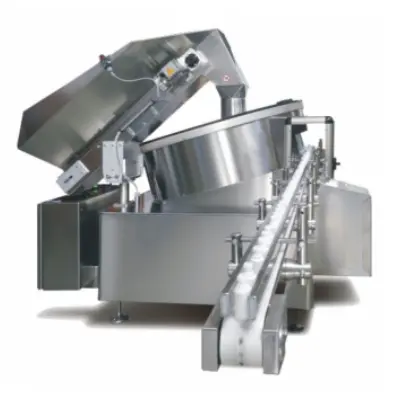
Complete centrifugal feeder system with bowl, outfeed, controls and supporting frame
Whole-system valuePrice should reflect the equipment needed to create accepted production output.
Lifecycle value

Calculate more than purchase price.

Commercial value can come from reduced manual loading, higher line availability, consistent part presentation, lower reject rates and better use of downstream machinery. The business case should also include changeover time, maintenance access, spares, operator attendance and recovery after faults.

Where an existing feeder is available, compare modification against a new system using the same acceptance criteria. Reusing the drive or bowl may reduce capital cost, but only if condition, geometry and capacity support the new component.

Centrifugal feeder pricing FAQ

Answers before requesting a quote.

How much does a centrifugal feeder cost?

A reliable price cannot be set from bowl diameter alone. The total depends on the component, orientation tooling, sustainable rate, hopper, outfeed, sensors, controls, guarding, documentation, trials and production-line integration.

Why are centrifugal feeder prices application-specific?

The tooling and handling route are developed around the real part and accepted presentation. Two components of similar size can require very different separation, rejection, recirculation and verification methods.

What should a centrifugal feeder quotation include?

A useful quotation should define the approved component range, accepted orientation, sustainable output boundary, feeder and tooling, bulk loading, discharge route, controls, guarding, trials, documentation, installation scope and exclusions.

Does a higher feed rate always increase the price?

Often it increases complexity, but not every higher rate needs a larger machine. Tooling yield, lane count, buffer design and downstream demand can matter more than nominal bowl speed. Trials determine the practical architecture.

Can an existing feeder be modified for a new component?

Sometimes tooling, tracks or controls can be altered, but the drive, bowl geometry, condition and required output must be assessed. Reuse should be compared with a new system on performance, risk and lifecycle cost.

What information is needed for a budget estimate?

Provide part photographs or drawings, dimensions, all variants, required orientation, target accepted parts per minute, downstream-machine details, available space, utilities, environment and expected project timing.

Commercial guidance reviewed by Sortation Solutions · Updated 1 September 2026

Start with the component

Need reliable orientation at production speed?

Send a part photograph or drawing, required orientation, target sustained output and details of the receiving machine. We will define the right next step.

Call 01844 617223 Enquire