Contact boundary
Identify every surface, tool and transport element that can touch the approved component.
Engineer automatic orientation around the real device part, contact requirements, inspection boundary and customer-defined quality evidence.
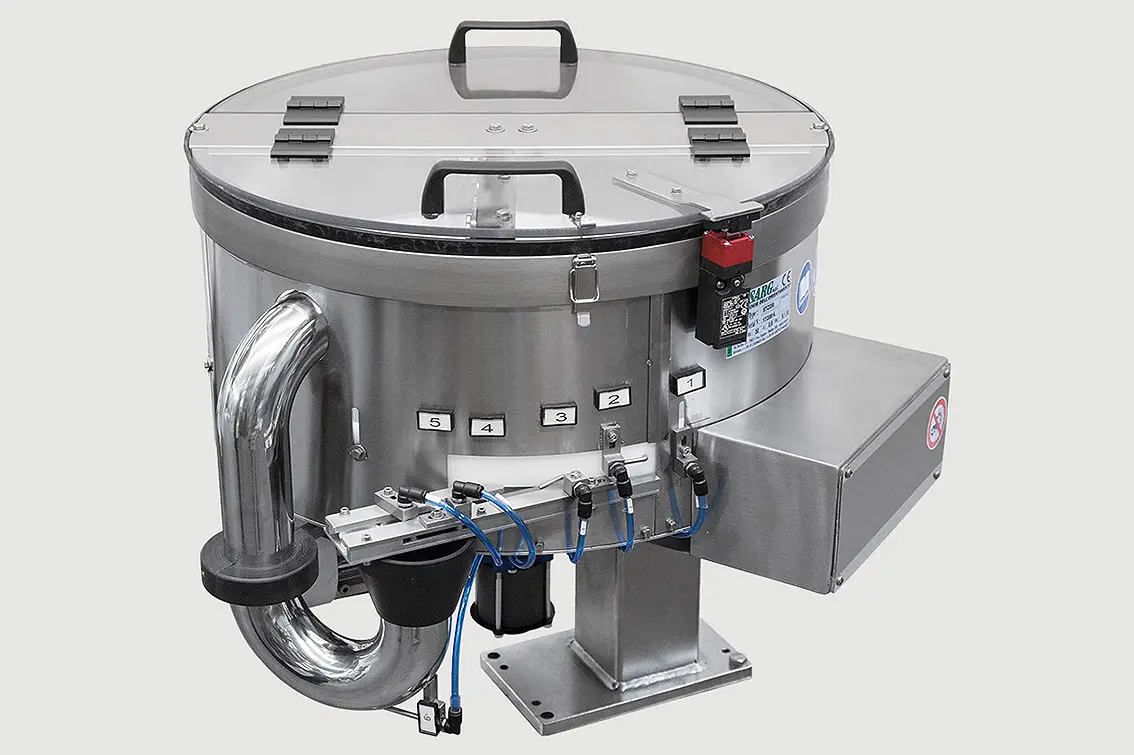
A centrifugal feeder may suit a repeat-volume rigid component that must be separated and orientated at a demanding rate. The part needs stable geometry and a robust selection feature, while the equipment scope must address the customer’s cleanliness, contact, traceability and validation needs.
Selection is based on representative production samples. Surface damage, particulate generation, static, nesting and recirculation are assessed before the feeding principle is confirmed.
“Medical grade” is not a complete requirement. The customer’s product, environment, risk controls and documentation determine the final construction and verification scope.
Identify every surface, tool and transport element that can touch the approved component.
Define access, removal, cleaning method, agents, inspection and any changeover line-clearance steps.
Set acceptance limits for marks, burrs, dust, deformation, electrostatic effects and repeated circulation.
Plan format identification, purge points, trapped-part control and verification between production variants.
Specify each visible attribute, sample boundary, no-read rule and confirmed reject path.
Vision inspection guidance →Agree drawings, material records, test protocols, results, software records and handover documents.
These component families may be assessed where geometry and process controls support automated feeding. Suitability is never assumed from the product name alone.
Suitable caps, housings, actuator parts and protective elements for assembly or packaging.
Rigid mouldings, caps and defined components presented to assembly equipment.
Cartridge, cassette or device components where orientation and visible features are controlled.
Suitable shields, caps and housings assessed for handling damage and required presentation.
Pharmaceutical caps, plugs and device closures for capping, insertion or inspection.
Rigid trays, fitments or line components where the specified hygiene and material controls can be met.
A useful sample set covers every approved mould, cavity, colour, material, supplier and revision. Include normal production variation and difficult conditions such as static, flash or surface contamination where these can occur. Samples should be identified and traceable to the agreed trial record.
Centrifugal feeding repeatedly returns wrong presentations until they reach an accepted state. The trial should therefore evaluate cumulative contact, marking, particulate and any feature that could be damaged by repeated circulation. The design may use selected surfaces, tool profiles, controlled speed or a route that limits recirculation.
The required cleaning approach may range from accessible dry wipe-down to removable product-contact parts or a more controlled procedure. Specify cleaning agents, permitted materials, access, drainage if relevant, inspection points and how parts trapped during a changeover are detected and removed.
Orientation verification is different from defect inspection. State every required visible check, the permitted tolerance, good and reject samples, camera view, reject destination and response to a no-read. Where results must be recorded, define the data, retention and interface at the start.
Required documents can materially affect design, controls, testing and commercial cost. List the customer’s drawing, material, risk, software, calibration, FAT, qualification, traceability, training and change-control expectations before quotation. Do not assume a generic document pack will satisfy a regulated process.
This page describes engineering considerations, not a declaration that a standard feeder is suitable for a particular medical product, controlled environment or validation regime.
They can be suitable for rigid components whose geometry supports controlled separation and orientation. The decision also depends on surface sensitivity, particulate risk, cleanability, contact materials, approved environment and customer validation requirements.
Potential candidates include suitable caps, housings, needle shields, inhaler parts, diagnostic-device mouldings, applicator parts and other rigid components. Every application requires a sample-led review; this list does not confirm suitability.
Cleanability must be designed into the agreed scope. Requirements may include accessible contact surfaces, removable format parts, selected materials, documented cleaning methods and controls that prevent cross-contamination between variants.
Yes. Vision may verify visible orientation, presence, colour, assembly features or defined defects. The inspection capability must be proven using approved good, reject and borderline samples under representative conditions.
Documentation is project-specific. The customer should state required risk, design, test, material, software, calibration, traceability and qualification records at enquiry stage so they are included in the commercial and technical scope.
Technical content reviewed by Sortation Solutions · Updated 1 September 2026
Send a part photograph or drawing, required orientation, target sustained output and details of the receiving machine. We will define the right next step.
Share a photograph or drawing, required orientation and target rate. The Sortation Solutions team will help identify the strongest feeding route.