Regulated loading
A bulk hopper meters parts so the disc carries a consistent working quantity.
Turn random bulk components into high-flow, correctly presented output using a rotary sorter engineered around the real part.
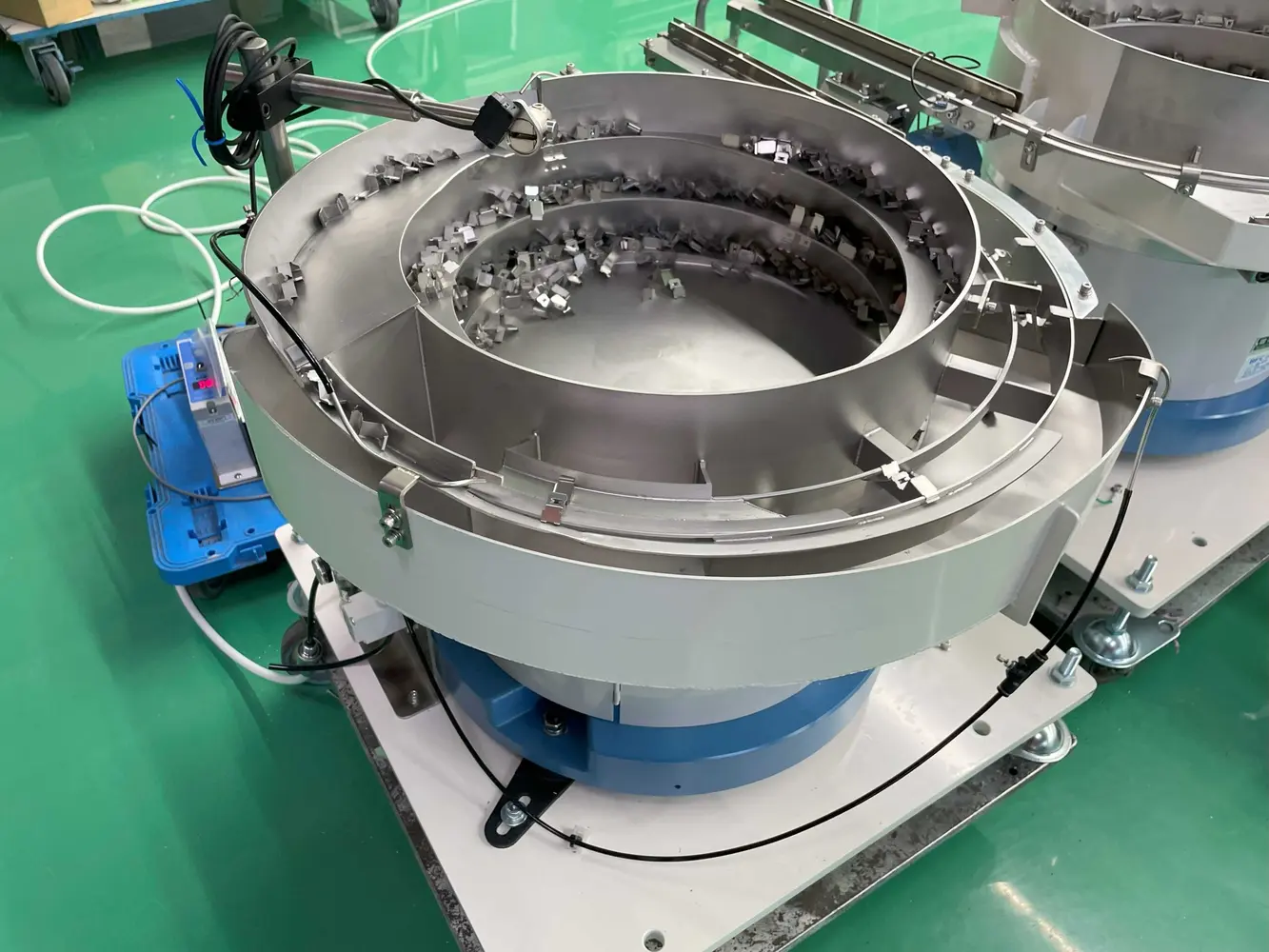
Centrifugal feeder, centrifugal bowl feeder, parts unscrambler, rotary sorter, rotary orientor and parts orienter can all refer to closely related equipment. A driven centre disc moves bulk components outwards; tooling around the perimeter selects the usable presentation and returns wrong states for another pass.
The important question is not the label. It is whether the complete system can supply accepted parts at the required hand-off, without unacceptable marking, jams or operator intervention.
Stable output comes from managing the entire population—not just accelerating parts around a bowl.
A bulk hopper meters parts so the disc carries a consistent working quantity.
Rotary movement spreads components and moves them towards the perimeter selection area.
Geometry, centre of gravity, tooling or vision distinguishes accepted and wrong presentations.
Wrong-way parts return with controlled energy and without disrupting accepted flow.
Accepted parts enter a track, belt or air conveyor that preserves orientation.
Buffer sensors and an escapement deliver parts in step with the receiving process.
Suitability must be confirmed using representative samples. These examples describe common starting points, not guaranteed applications.
Screw caps, overcaps, lids, rings and dispensing closures for capping or assembly.
Cap feeder guidance →Housings, inserts, clips and formed components where static and interlocking are assessed.
Plastic feeding guidance →Suitable rigid device parts requiring controlled contact, cleanability and documented acceptance.
Medical applications →Clips, washers, connectors, mouldings and small parts for assembly or inspection.
Automotive applications →Connector bodies, insulators, covers and terminals with identifiable orientation features.
Suitable rings, fixings, pressings, fittings and consumer-product components.
A packaging-line bottle unscrambler typically raises randomly loaded containers and presents them upright. A centrifugal parts sorter usually handles smaller components and uses perimeter tooling to establish a specific face, end or feature. Some packaging components—such as caps, pumps, triggers and fitments—sit between these categories, so the project should be described by the required output rather than a generic machine name.
Centrifugal systems use continuous rotary movement and are often considered for high-flow, relatively stable parts. Vibratory bowls move parts along a track using controlled vibration and can solve a wide range of dedicated tooling problems. Neither is universally better. Compare the component, required rate, surface sensitivity, noise, format life and downstream interface.
Read the detailed centrifugal versus vibratory feeder comparison.
Too many parts can create overlap, pressure, collisions and reduced orientation yield. Too few create empty track and erratic output. A level-controlled pre-feeder is therefore part of performance engineering, not an optional storage accessory.
Measure correctly presented components at the agreed discharge point. The test should use approved variants, normal replenishment and realistic accumulation. Record recirculation, marking, misorientation, jams, interventions and recovery after a stop or full-track condition.
Components that strongly tangle, nest, change shape, have extremely delicate surfaces or require frequent unrelated format changes may favour a step feeder, vibratory bowl, flexible feeder or robotic presentation. An evidence-led trial prevents the terminology from driving the technology choice.
In component automation, “centrifugal feeder,” “rotary sorter,” “parts unscrambler” and “rotary orientor” are often alternative names for equipment that separates and presents bulk parts using rotary motion.
The terms often describe the same rotary principle: bulk parts are separated, moved to perimeter tooling and discharged in an accepted presentation. Unscrambler emphasises changing random bulk parts into ordered flow; feeder emphasises supplying the next process.
A rotary parts sorter uses a driven disc or bowl and application-specific tooling to separate components, reject unwanted states and pass accepted parts to one or more outfeeds. In this context it is another common name for a centrifugal feeder or orientor.
Not always. A bottle unscrambler usually stands containers upright for a filling line. A centrifugal parts unscrambler can handle smaller components such as caps, closures, mouldings, clips or medical parts and may establish a more specific orientation.
Yes, where component geometry and the downstream process support it. Each lane requires stable selection, balanced flow, appropriate buffering and independent demand control.
Mechanical tooling, sensors or vision identify unsuitable presentations. They are normally returned to the active part population or diverted to a controlled reject path, depending on the application and quality requirement.
Technical content reviewed by Sortation Solutions · Updated 1 September 2026
Send a part photograph or drawing, required orientation, target sustained output and details of the receiving machine. We will define the right next step.
Share a photograph or drawing, required orientation and target rate. The Sortation Solutions team will help identify the strongest feeding route.